
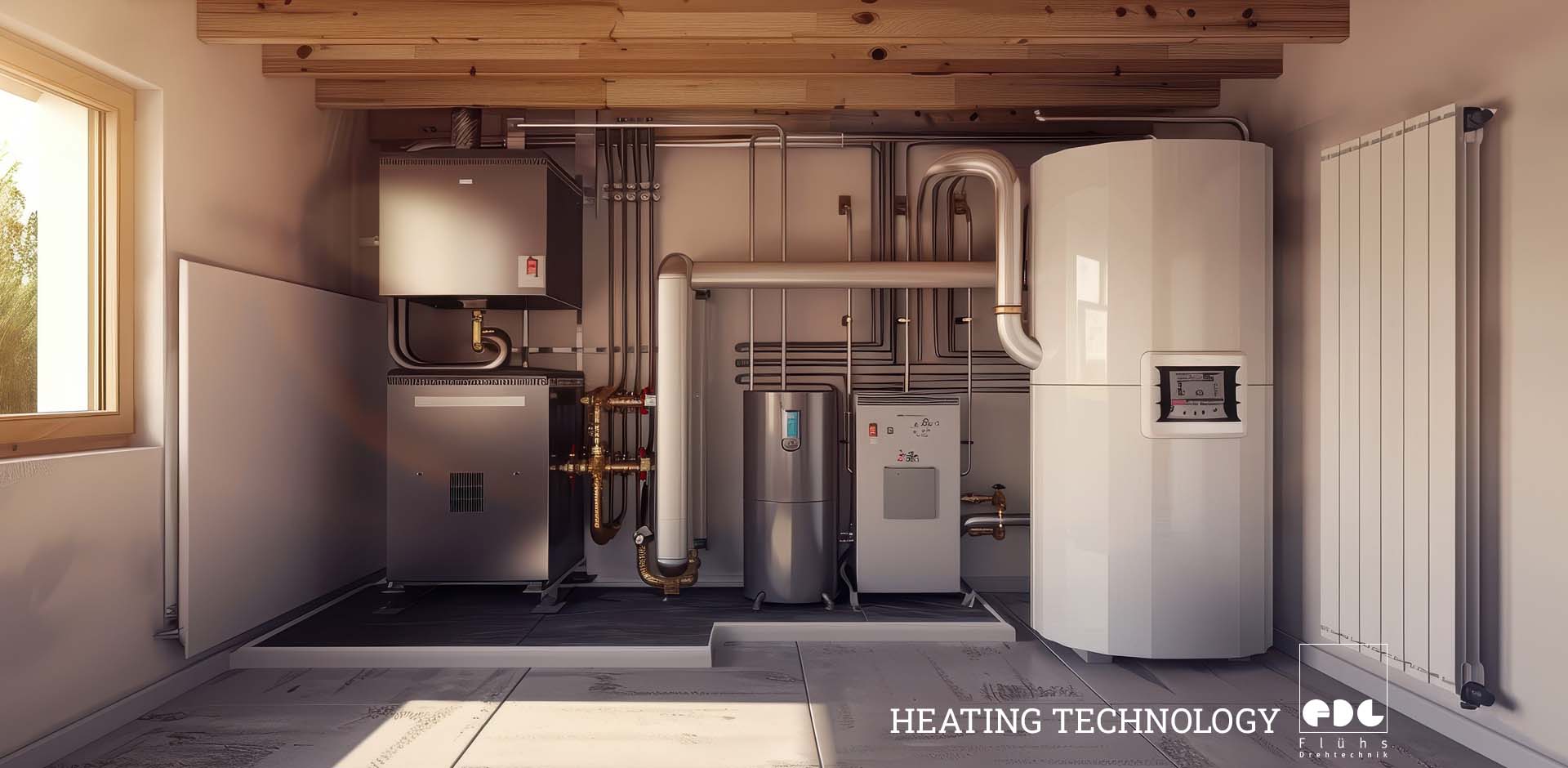
Heating Technology: Definition & Basics
Heating technology is a subfield of building services engineering that deals with the supply of heat to residential, industrial, and commercial buildings. Flühs Drehtechnik manufactures high-quality heating valves and complex assemblies for heating technology. Heating technology encompasses the planning and installation of heating pipes, boilers, radiators, and other systems used to supply heat to a building.
Heating technology includes systems for generating, distributing, and delivering heat, such as boilers, heat pumps, pipes, storage tanks, surface heating systems (such as underfloor or wall heating), and control technology. There are various options for generating heat, for example, using a heat pump, solar thermal energy, or the combustion of fuels. In heating technology, radiators or panel heaters are used to emit heat. Radiators are, for example, heaters that are visibly installed in the room. Panel heaters are, for example, underfloor heating systems that heat a specific area in the room.
This text explains the basics of heating technology, describes what heating technology is, and outlines possible career paths.
What is heating technology?
Heating technology is a subfield of building services engineering. It deals with the generation, distribution, and delivery of heat in enclosed spaces.
In heating technology, heat is generated by boilers, heat pumps, or solar thermal energy. Boilers burn fuel such as gas or oil. A heat pump works by extracting thermal energy from the ambient air, the ground, or groundwater. The heat pump converts the environmental energy obtained through evaporation, compression, and condensation into usable energy and transfers it to the heat distribution and storage systems.
Solar thermal heating systems work by using collectors to capture solar radiation and convert it into thermal energy. The sun's rays heat the fluid in the collectors, a mixture of water and antifreeze, which transports the heat into the building.
Heat is distributed via heating pipes in a single pipe or two pipe system. In a single pipe system, all radiators are arranged in series in a single pipe. In a two pipe system, there are 2 separate pipes, consisting of a flow pipe and a return pipe. The flow pipe transports the heated heating water to the radiators. The return pipe returns the cooled water to the heat generator.
Heat is emitted in heating technology through radiant heat and convection heat. Radiant heat is electromagnetic radiation that heats objects when the rays strike them. Convection heat is a heating method that heats the air and distributes it throughout the room by warming air on warm surfaces (such as radiators) and expanding it. Radiators mainly emit convection heat and warm the air, while panel heaters mainly emit radiant heat.
Control technology is an important part of heating technology, ensuring that the temperature is regulated according to demand. Control technology is responsible for ensuring that heat is distributed evenly and optimally throughout the building. It ensures that the heating water arrives at each radiator or surface heating system at the same flow temperature and pressure. Examples of control technology are weather-compensated and room temperature-compensated control. In weather-compensated control, an outside temperature sensor controls the flow temperature. In room temperature-compensated control, a sensor measures the room temperature. Thermostats are used to control the individual room temperature.
One example of heating technology in practice is the installation of oil heating in a building. To ensure an efficient heating system, the heat distribution systems (pipes) and heat transfer systems (radiators or panel heating) are planned accordingly. When planning heating systems, building-specific and legal factors are taken into account. These include insulation values, compliance with the German Building Energy Act (GEG), compliance with applicable DIN standards, pipe laying methods, pressure and temperature requirements, and material selection.
The skills and theoretical knowledge are taught in the fundamentals of heating technology, which are then expanded upon in degree programs and training courses.
Basics of Heating Technology
The basics of heating technology encompass knowledge of all functions and technical components involved in heat generation, heat distribution, and heat dissipation. This includes specialist knowledge of the installation, maintenance, and repair of heating systems such as gas heating systems, heat pumps, and solar thermal heating systems.
Various degree programs and training courses provide in-depth knowledge of the fundamentals of heating technology. Possible degree programs in the field of heating technology include energy and building technology or supply engineering. Training as a plant mechanic for sanitary, heating, and air conditioning technology is a suitable training option in heating technology.
The energy and building technology degree program teaches theoretical knowledge of heating technology, such as the design and planning of technical building equipment (HVAC). Content on green building engineering (GBE) for sustainable planning and certification of buildings is integrated into the degree program. Some universities of applied sciences offer the option of completing a dual study program. The dual study program combines a bachelor's degree with training as a plant mechanic in sanitary, heating, and air conditioning technology.
A plant mechanic for sanitary, heating, and air conditioning technology installs, maintains, and repairs sanitary facilities as well as heating, ventilation, and air conditioning systems. Training to become a plant mechanic in this field takes 3.5 years. After completing the training, it is possible to continue training to become a state-recognized technician specializing in heating, ventilation, and air conditioning technology. This takes 2 years and builds on the practical skills already learned during the training to teach skills in project management, organization, and technical process optimization.
Heating Technology Products from Flühs
Flühs manufactures high-quality heating technology products, including turned part assemblies for a wide range of heating systems and precisely manufactured valves.
In the field of heating valves, Flühs primarily acts as a supplier of precision turned parts that are used as components in heating technology. These turned parts are also assembled into complete (valve) assemblies on fully automated assembly machines. These include drain valves, which are used to control the discharge of excess water from heating pipes. Flühs is a development partner for German semi-finished product manufacturers. We focus in particular on the development of sustainable, lead-free copper-zinc alloys. We source our raw materials, such as brass rods and profiles, exclusively from high-quality semi-finished product manufacturers.
Our production facilities comprise more than 130 CNC and cam-controlled lathes, which are exclusively operated by trained specialists. The majority of our production processes are fully automated, ensuring consistent and precise results. Fully automated assembly machines are also used in the assembly area.
Heating Technology as Part of Building Services Engineering
Heating technology is a part of building services engineering that deals with technical installations in the fields of heating, ventilation, sanitation, and electrical engineering.
Building services is an umbrella term for all building technology disciplines that deal with the energy and infrastructure supply of residential, industrial, and commercial buildings. There are technical interfaces between sanitary and heating technology in buildings. Drinking water heaters in buildings work, for example, by means of heating technology, boilers, or instantaneous water heaters. Solar thermal systems use shared storage tanks for heating and hot water production. Plumbing and heating water systems can be integrated into a building management system that is controlled by a shared control unit. Plumbing and heating technology are therefore closely linked as building services disciplines.