
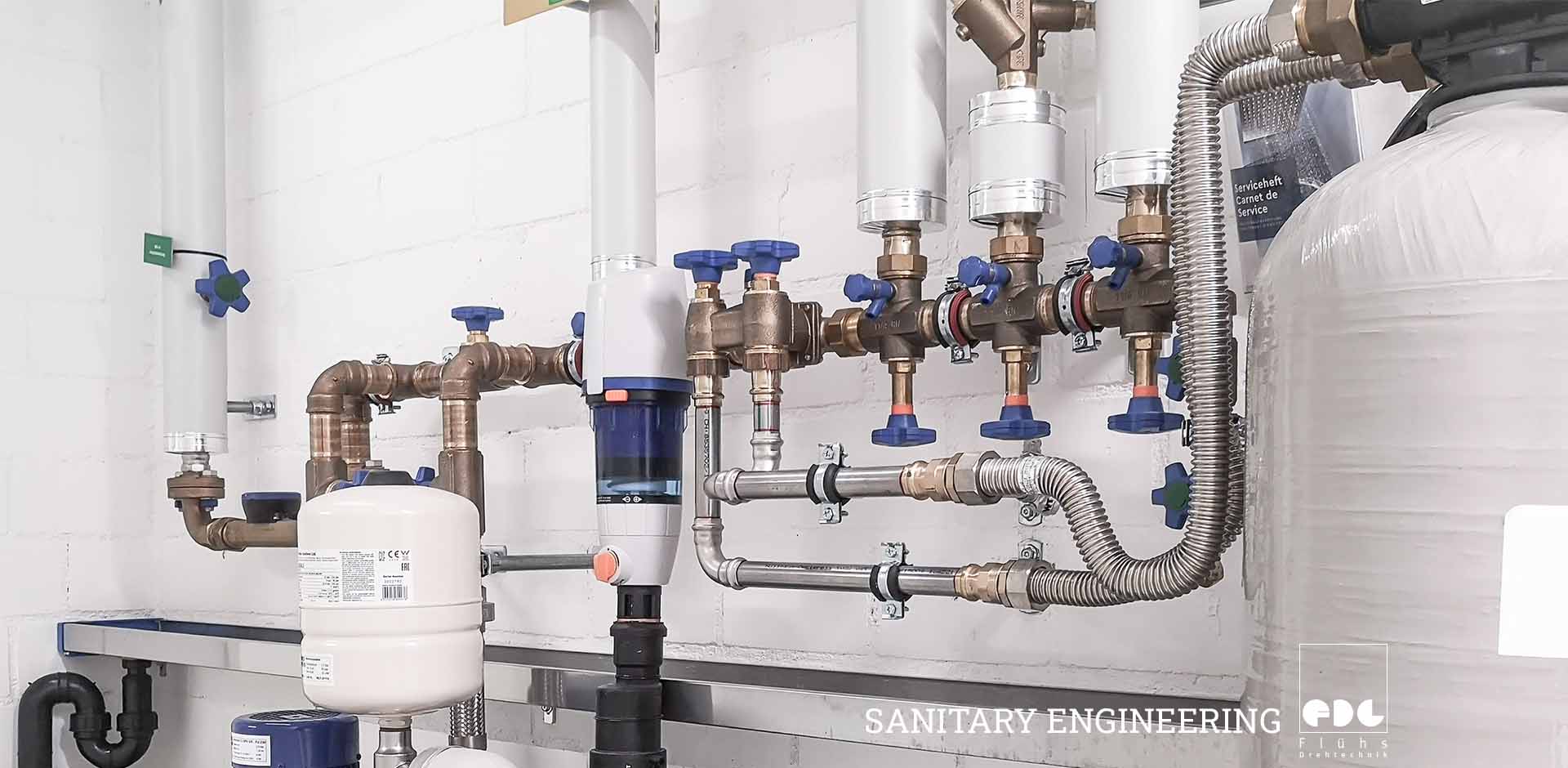
Sanitary Engineering: Definition & Basics
Sanitary engineering encompasses everyday technical installations such as kitchen and bathroom fittings and forms the basis for reliable water supply and wastewater disposal. Flühs Drehtechnik is a leading system supplier to the sanitary industry, specializing in valve technology in particular.
Sanitary engineering ensures a hygienic drinking water supply and prevents contaminated wastewater from entering the drinking water network. Typical sanitary engineering components include pipes, valves, water filters, faucets, and shower heads.
Sanitary engineering is a comprehensive field that is the subject of various recognized training programs and courses of study. In this context, the terms “sanitary engineering” and “building services engineering” are often used, whereby building services engineering includes other disciplines (electrical, ventilation, and heating supply technology) in addition to sanitary engineering.
The following text explains the most important basics of sanitary engineering. The following describes what sanitary engineering is, what it encompasses, and how it fits into the field of building services engineering.
What is sanitary engineering?
Sanitary engineering is a central component of supply engineering that deals with technical installations for water supply and wastewater disposal in households and businesses.
Sanitary engineering is used in households, swimming pools, saunas, companies, and businesses of all kinds, among other places. In residential and workplaces, sanitary engineering ensures the supply of drinking water and wastewater disposal, while in industry and agricultural businesses, water systems for industrial purposes (for instance, for rainwater recovery) are also frequently installed.
Sanitary engineering installations (or plumbing installations) serve the purpose of providing clean and hygienic drinking water in the required quantities. Plumbing installations include water pipes, water meters, taps, and shut-off valves.
Sanitary Engineering serves to maintain hygienic standards. Plumbing systems such as piping systems, valves, and filters ensure that clean water is provided and wastewater is disposed of efficiently. This helps to prevent germs from spreading via drinking water and thus avoids related diseases.
Sanitary engineering components are subject to particularly high requirements in terms of corrosion resistance and wear resistance, as they are used daily and are constantly exposed to contact with water and wastewater. Different materials are therefore used for sanitary components, like porcelain and ceramics for washbasins and showers, and metals and non-ferrous metals (NF metals) as well as plastics for pipes, fittings, and valves.
Sanitary engineering is an integral part of private and commercial buildings and is used for drinking water supply and treatment in compliance with hygiene standards. Sanitary engineering has various sub-areas, which are described in the following.
What does sanitary engineering encompass?
Sanitary engineering encompasses all technologies and installations for supplying water to buildings and disposing of wastewater, like pipes, fittings, and valves for bathtubs, washbasins, toilets, etc.
Sanitary engineering includes the installation and construction of drinking water pipes, sewage pipes, and drainage systems. The pipe systems ensure a reliable water supply and wastewater disposal, as well as compliance with hygiene standards.
The provision of clean drinking water and the efficient disposal of wastewater is achieved through pipe networks, fittings, valves, and pumps. These sanitary engineering components ensure that water is reliably supplied to buildings and wastewater is discharged. PE pipes are often used for piping in drinking water and service water systems. PE pipes are thermoplastic polyethylene pipes that are suitable for installation in drinking water and service water systems and offer a high degree of flexibility. Unlike PVC pipes, PE pipes are easy to bend, but are less weather-resistant.
In addition to providing clean drinking water, sanitary engineering also deals with hot water supply. Installations for hot water supply include instantaneous water heaters, boilers, and solar thermal systems. Thermostatic devices and circulation pumps are among the components used in hot water supply systems. Pipes in hot water supply systems are often made of HT pipes. HT pipes (high-temperature pipes) are special polypropylene drain pipes that can withstand wastewater temperatures of up to 95°C and are therefore often used to drain hot water.
Wastewater disposal is another area of application for sanitary engineering. Wastewater disposal involves the drainage of contaminated water from the building and subsequent treatment in a sewage treatment plant. Innovative recovery technologies, such as biogas production, are also used in the field of wastewater disposal and treatment. Pipes for wastewater disposal are often made of PVC (polyvinyl chloride), as the smooth inner surface minimizes deposits and blockages.Compared to PE pipes, PVC pipes have the advantage of being more robust and durable, but they are also more rigid than PE pipes.
The following section describes the basics of sanitary engineering and possible training and study programs in sanitary engineering.
Basics of Sanitary Engineering
The basics of sanitary engineering encompass basic knowledge relating to the planning and installation of drinking water and service water systems for various buildings. These basics are taught in vocational training or as part of a degree program.
Trained sanitary engineers, also known as plant mechanics for sanitary, heating, and air conditioning technology, plan and install water and air supply systems. Training to become a plant mechanic for sanitary, heating, and air conditioning technology takes 3.5 years. During their training, apprentices learn skills such as how to assemble and manufacture sanitary assemblies and how to install drinking water, service water, and wastewater systems, as well as heat generation systems and ventilation and air conditioning systems.
There are various degree programs in Germany in the field of sanitary engineering. These include, for example, building and energy technology (B.Eng.) at different universities or further training as a state-certified technician specializing in sanitary engineering at a technical college. Successful completion of training in the relevant field is usually required for further training as a state-certified technician. Further training as a state-certified technician specializing in sanitary engineering takes 2 years. The bachelor's degree program in building and energy technology takes 3 years.
In the building and energy technology degree program, sanitary engineering is just one of the building technology disciplines covered. The program includes teaching specialist knowledge of heating technology, air conditioning technology, sanitary engineering, electrical engineering, measurement and control technology, and, where applicable, energy and environmental technology. In the continuing education program to become a state-certified technician specializing in sanitary engineering, the focus is on planning and construction management for the installation of sanitary facilities. This means that prospective technicians learn, among other things, how to set up construction drawings and assembly plans and how to coordinate work processes on construction sites.
There are numerous books on the basics of sanitary engineering that provide helpful basic knowledge for studies or training. A book on the basics of sanitary engineering covers topics such as the manufacture and assembly of components, as well as the maintenance and installation of technical systems.
Sanitary Engineering Products from Flühs
Sanitary engineering products from Flühs include shut-off valves, check valves, mixing valves, and thermostatic valves, which are suitable for drinking water systems.
Flühs has been manufacturing sanitary engineering assemblies for valve and system technology since the 1970s. We are an important system supplier and partner to the sanitary industry and are active not only in production but also in development.
Flühs currently has around 1,400 active valve assemblies. Our Lifetime and Classic valve headworks are our bestsellers, each of which has sold more than 500 million units worldwide. The Lifetime headwork is a patented product that has taken a market-leading position. It is equipped with wear-resistant ceramic sealing discs that have a diamond-like hardness thanks to the aluminum oxide contained therein. Our Classic valve headwork ensures particularly quiet operation and maximum ease of use thanks to its high-quality cone seal.
Flühs valve assemblies are developed in close cooperation with our customers to deliver tailor-made solutions for individual requirements. Our in-house R&D department develops customized and innovative assemblies in small to large series that can be integrated into the system technology specified by the customer.
We use CNC lathes in production, which guarantee maximum precision and cost-effectiveness. Accompanying quality controls ensure that our high quality standards are met. Various instruments and tools are used for this purpose, such as 3D coordinate measuring machines.
During assembly, we put together the turned parts we produce and carry out an additional leak test on valves. We deliver either ready-to-assemble valves or individual assemblies as a complete solution that can be assembled by the customer themselves.
Flühs products can be used in sanitary and building services engineering. Building services engineering encompasses all fixed installations, equipment, pipes, and lines in the areas of heating, sanitation, electrical, and ventilation.
Sanitary Engineering as Part of Building Services Engineering
Sanitary engineering is a part of building services engineering that deals with technical installations (such as drinking water pipes and fittings) and wastewater disposal.
Building services engineering is a common synonym for building technology and refers to all technical systems and installations in a building, such as electrical, ventilation, heating, and sanitary engineering equipment and systems. In some cases, building services refers exclusively to building services systems in residential buildings, whereas building technology also refers to more specialized buildings such as production facilities, data centers, etc. Sanitary engineering is limited to technical systems and installations for drinking water and hot water supply as well as wastewater disposal. It is therefore a sub-discipline of building services engineering.
Flühs' valve and system technology assemblies can be used in sanitary and building services engineering. Sanitary engineering includes, for example, single-lever fittings, two-handle fittings, and thermostatic fittings. In addition to components for the sanitary industry, Flühs also manufactures assemblies for heating valves, which fall within the scope of building services engineering.
Sanitary engineering is an important part of building services engineering, which ensures a reliable supply of water, electricity, and heat for buildings.