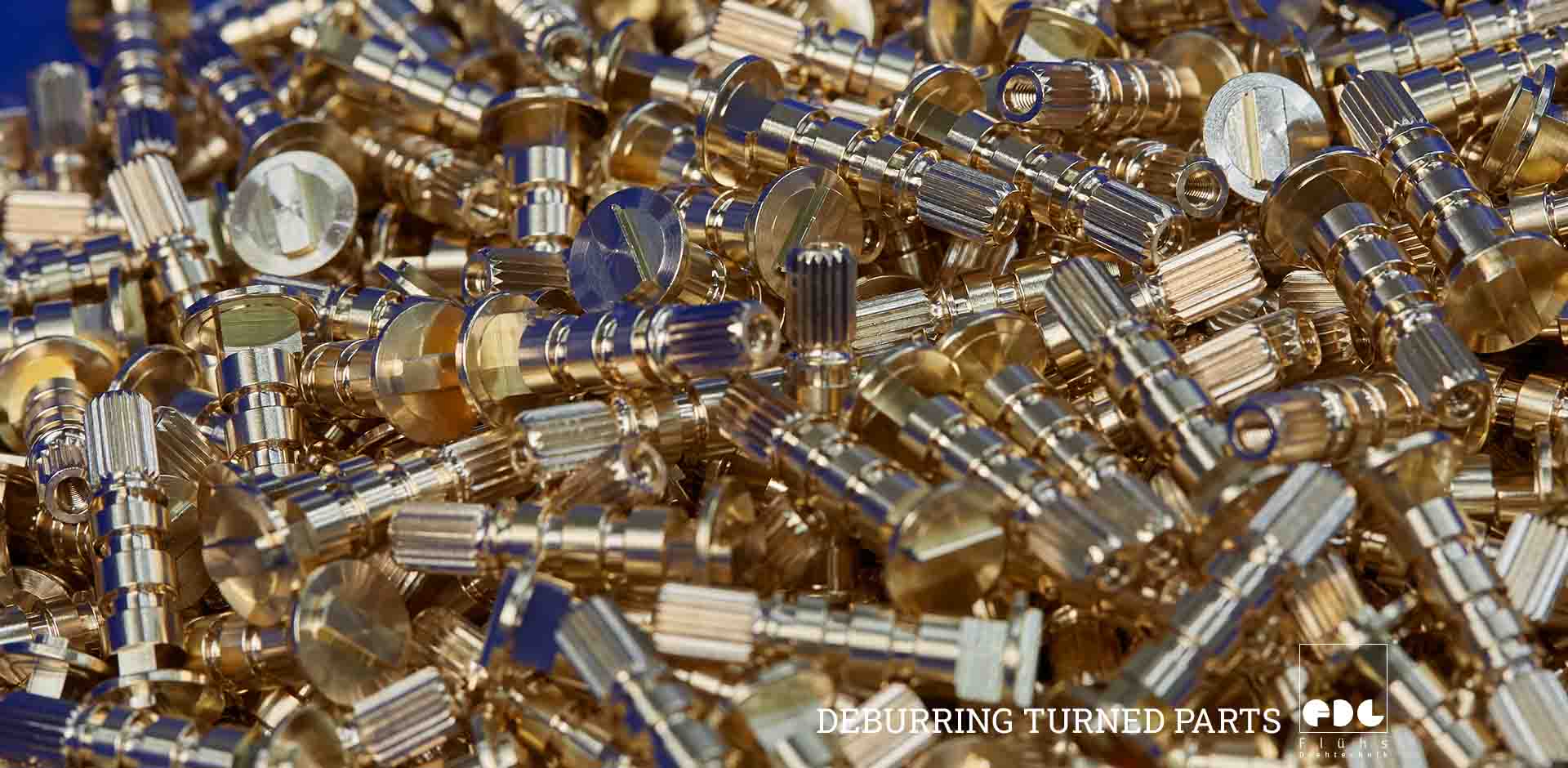
Deburring Turned Parts

Deburring Turned Parts: Definition & Services | Flühs

We are specialists in deburring turned parts, as deburring is an integral part of our manufacturing process for high-quality turned parts. Deburring turned parts involves removing burrs, splinters, and chips from the workpiece and smoothing sharp edges.

Contact us

The aim of deburring is to achieve an even, smooth surface that ensures a defined surface quality for downstream machining processes (such as the assembly of valves from individual components) or coating processes (chromium plating, nickel plating, etc.). At the same time, removing sharp edges reduces the risk of injury to employees and increases safety in the production process. Deburring encompasses several processes, such as thermal deburring, electrochemical deburring, and mechanical deburring. In these processes, the workpieces are subjected to different mechanical and thermal stresses in order to remove the burrs.

In the following, we explain what deburring of turned parts is and provide a broad overview of the methods used in the process.

What is the deburring of turned parts?

The deburring of turned parts is an industrial process for removing burrs, splinters, and fraying that occur on the surface of workpieces during machining processes such as drilling, milling, or turning.

Burrs occur during industrial machining processes. Burrs are caused by material displacement at edges and cut surfaces. They impair the dimensional accuracy, functionality, and further processability of the workpieces. Sharp edges and splinters pose a hazard when handled by employees. For these reasons, they must be completely removed.

When manufacturing workpieces by drilling, milling, or turning, burrs are created as a result of material displacement during machining. There are several factors that influence the size and nature of the burrs. These include, for example, high feed rates, the condition of the tool, incorrect machine settings, and material properties. Blunt cutting edges or brittle, hardened materials often lead to larger burr formation.

According to DIN ISO 13715, a burr is an irregular edge elevation that occurs during the machining of a workpiece and results in a deviation of > 0.05 mm from the ideal geometric shape. The edge shape has a significant influence on burr formation. Edge angles < 30° or heavily chamfered edges over 150° are hardly prone to burr formation. In contrast, sharp edge angles and high cutting forces promote the formation of pronounced burrs. Burrs located on inner sides or in hard-to-reach areas are considered particularly difficult to remove. The more massive a burr is, the more limited the available deburring methods are. Therefore, burr-minimized manufacturing through optimized process control is an important goal in production planning.

Depending on the workpiece, geometry, and requirements, different deburring methods are used, such as mechanical deburring with brushes, files, grinding tools, or deburring knives, as well as thermal and electrochemical deburring methods. Automated deburring systems enable reproducible, reliable processing even with complex workpiece shapes or high quantities. The process is selected based on the material, burr characteristics, accessibility, and required surface quality.

There are several methods for deburring turned parts, which are described below.

How are turned parts deburred?

Turned parts are deburred using methods such as electrochemical deburring, thermal deburring, mechanical deburring, water jet deburring, and cryogenic deburring.

Electrochemical Deburring

Electrochemical deburring (ECM) is a contactless cutting process in which burrs are dissolved by an electric current in an electrolyte. ECM deburring enables a high standard of quality thanks to automated processing with ECM tools and saves costs by reducing the number of scrap parts. Mechanical deburring is particularly difficult for burrs that are difficult to access, for example in gear, motor, hydraulic, and pneumatic parts, which is why ECM deburring is suitable for these applications.

Thermal Deburring

Thermal deburring or TEM (Thermal Energy Machining) is an abrasive manufacturing process in which a mixture of oxygen and hydrogen, natural gas, or methane is fed into a hermetically sealed deburring chamber and ignited. The burrs are burned off and removed by oxidation during this controlled explosion. Thermal deburring is used in the automotive industry, particularly in hydraulics and pneumatics, where mechanical processing reaches its limits. Examples include valve housings, hubs and gears.

Mechanical Deburring

Mechanical deburring is a deburring process in which burrs are removed by direct material removal using tools such as brushes, files, sandpaper, or polishing compounds. Typical tools used for deburring are files, sandpaper, and wire or nylon brushes. Mechanical deburring is a cost-effective process with good result control that is suitable for many materials. In the case of manual deburring methods, it is very time-consuming and may produce qualitative differences between the results. Mechanical deburring with tools (like brushes) results in high tool wear over time.

Water Jet Deburring

Water jet deburring is a high-precision process in which burrs and sharp edges are removed using a high-pressure water jet with a pressure of up to 4,000 bar. Water jet deburring is particularly gentle on materials, environmentally friendly, and allows for maximum precision. It is used, among other things, for precision components for engines and transmissions, as well as in precision engineering.

Cryogenic Deburring

Cryogenic deburring is a deburring process in which the respective molded parts are deburred with liquid nitrogen in combination with plastic granulate. Cryogenic deburring is particularly suitable for complex and delicate geometries, as the process enables precise and uniform machining. Cryogenic deburring is mainly used in the sealing industry for components such as O-rings. Cryogenic deburring prevents material wear and is particularly suitable for elastomeric molded parts such as O-rings in the sealing industry.

Pressure Flow Lapping (AFM)

Pressure flow lapping, also known as abrasive flow machining (AFM), is a surface finishing process used for reworking workpieces with complex external and internal contours. The workpiece is clamped into a fixture and an abrasive paste containing abrasive particles is applied to the surface. A rotating abrasive tool or disc then exerts pressure on the workpiece, removing material from the surface. Pressure flow lapping can be used to produce surfaces with very tight tolerances and to easily remove surface defects and microstructures.

We deburr turned parts: Flühs Drehtechnik

Flühs Drehtechnik places the highest quality demands on the turned parts it manufactures. The aim is to design the technical details of the components during the planning and manufacturing phase in such a way that the workpieces come off the machine as burr-free as possible. This makes it possible to largely avoid additional work steps, such as mechanical or thermal deburring, in order to ensure an economically efficient production process. If deburring is nevertheless necessary, Flühs uses both mechanical and thermal processes to optimize component quality. Flühs uses a wide range of technical options for surface finishing. These include its own diamond finishing equipment for high-gloss precision surfaces and external partner companies for grinding, polishing, and clarifying. Various finishing processes are also used, including electroplating and chrome plating, chemical nickel plating, powder coating, and modern PVD coatings. All measures serve the goal of providing functional, visually flawless, and durable turned parts of the highest quality.

Contact

Form

We're looking forward to your message

Please fill in the blanks below and send us your questions and requests.