Laser Engraving for Turned Parts: Laser Engraving for Turned Parts | Flühs
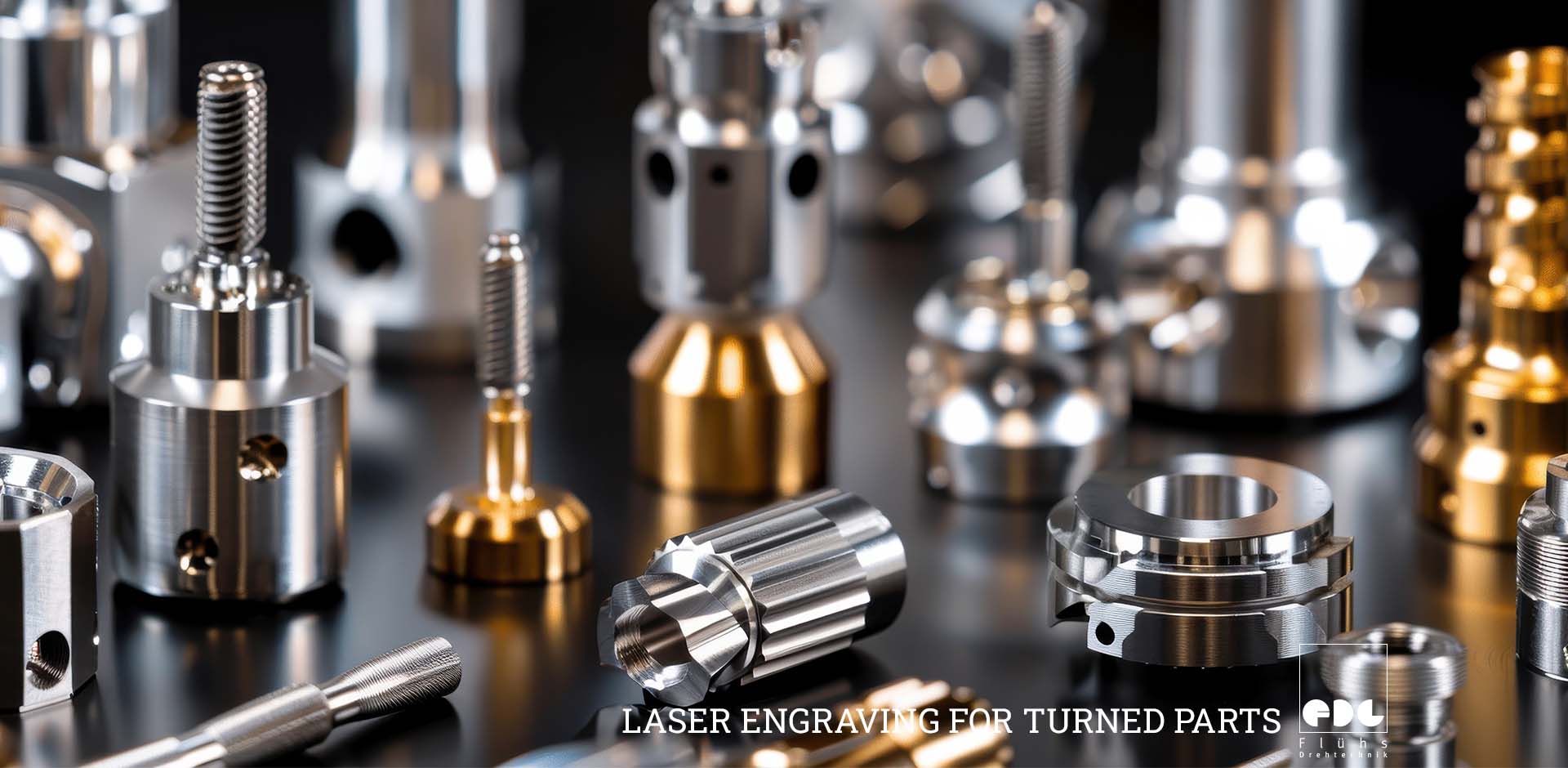
High-quality laser engraving allows turned parts to be marked permanently and precisely. Laser engraving involves engraving a permanent marking into turned parts using a powerful laser beam.
Flühs offers precisely manufactured turned parts made from numerous brass alloys that are suitable for laser engraving.
Laser engraving for turned parts is a way to personalize turned parts or mark them with serial numbers and similar information. Laser engraving can be used on almost all materials, including wood, plastic, and metals such as brass or steel.
On this site, we explain how laser engraving is performed on turned parts and why it is useful.
Laser Engraving for Turned Parts
Laser engraving for turned parts offers the possibility of permanent labeling and customizable marking.
aser engraving is a process used to label or mark objects using a powerful laser beam. The engraving depth is usually in the range of a few micrometers. A focused laser beam heats the material locally to a high temperature. Due to the high energy density, the material vaporizes (sublimates) or is thermally decomposed.
In contrast to laser marking, laser engraving vaporizes material, which changes the surface of the workpiece. This means that the intensity of the laser beam is lower for laser marking than for laser engraving.
Laser engraving for turned parts creates a specific lettering or pattern on the surface of the material by applying heat to the material using a laser beam, which penetrates a few micrometers into the surface. The laser beam has such a high concentrated energy that it removes parts of the material's surface. The material heats up at the points removed by the laser beam and reacts with the air, which may cause additional discoloration. The depth of the laser engraving varies depending on the laser beam intensity, impulse duration, beam focus, and material properties.
Laser engraving for turned parts can be performed with the utmost precision. The exact guidance of the laser beam, its intensity, and speed are computer-controlled.
The intensity of the laser beam required for laser engraving turned parts depends on the reflection behavior, density, and transition temperatures of the material.
Reflective materials usually require a higher intensity of the laser beam because they do not absorb all of the laser's energy. This is because part of the energy is emitted.
Materials with lower density require a lower intensity of the laser beam than materials with high density. The denser the material, the more molecules need to be heated for the laser beam to remove material from the surface.
The transition temperatures, such as the melting point or recrystallization temperature, vary depending on the material. The higher these individual temperatures for transitioning to a different state of the metal, the more energy the laser beam needs to produce a laser engraving.
Customers usually request laser engraving when the products need to be personalized or when certain industry-related markings are required on the turned part. However, laser engraving also offers many other advantages, which are described in the following section.
Why is laser engraving useful for turned parts?
Laser engraving is useful for turned parts because it allows them to be personalized and enables batch tracking. In addition, laser engraving is possible on almost all materials, including brass, stainless steel, and copper.
Laser engraving can be used to mark turned parts with barcodes, logos, or serial numbers. This marking is permanent and, unlike labels or similar markings, cannot be easily removed by external influences. Flühs valves are given their own code for traceability, which is applied by laser.
The long-lasting marking effect of laser engraving is advantageous in the electronics and medical industries, for example. Laser engraving makes it possible to identify components quickly and clearly, which plays an important role in electrical and medical technology.
In addition to the durability of the result, laser engraving on turned parts has many practical advantages, including compatibility with a wide variety of materials, low resource consumption and a fast overall process. No chemicals, printing inks, or solvents are used for laser engraving, and no additional tools such as chisels or punches are required, as the laser process is automated and does not require any human intervention.
Laser engraving on turned parts is characterized by high precision. It enables extremely fine and detailed patterns that are difficult to achieve with other engraving techniques. Laser engraving can be adapted to any material thickness. This flexibility opens up a wide range of possible applications.
Laser engraving of turned parts is just one of many surface treatments applicable to turned parts. Laser engraving is usually required when turned parts need to be customized with numbers or patterns according to the customer's specifications. Treatments such as polishing or bright turning, on the other hand, serve to enhance the appearance of the turned part or to facilitate further processing of the turned part.
Surface Treatments at Flühs Drehtechnik
Surface treatments at Flühs Drehtechnik include in-house fine turning, diamond turning, as well as electroplating, polishing, grinding, clarifying, PVD coating, and powder coating via external service providers.
-
Fine Turning
Fine turning serves to refine turned parts and achieve a special surface quality, like for precision turned parts.
-
Diamond Turning
Diamond turning ensures dimensional accuracy within 0.01 mm and surface qualities of Ra 0.2 µm. Diamond turning is used in particular for decorative parts, such as taps or other fixtures.
-
Electroplating
At Flühs, electroplating includes nickel plating, chemical nickel plating, and chrome plating.
-
Grinding, Polishing, Clarifying
These processes specifically improve the surface structure and ensure defined roughness or visually high-quality results. Polished and clarified surfaces are often used for visible parts.
-
PVD Coating
The PVD (Physical Vapor Deposition) process enables particularly hard and wear-resistant coatings with an elegant appearance. It is ideal for decorative and functional surfaces with high resistance.
-
Powder Coating
In powder coating, powder consisting of finely ground plastic particles with binders, pigments, and additives is applied electrostatically to the conductive workpiece. The workpiece is then heated in an oven, which causes the particles to harden. The result is a smooth surface that forms on the workpiece.
Turned parts manufactured by Flühs are fully suitable for laser engraving.