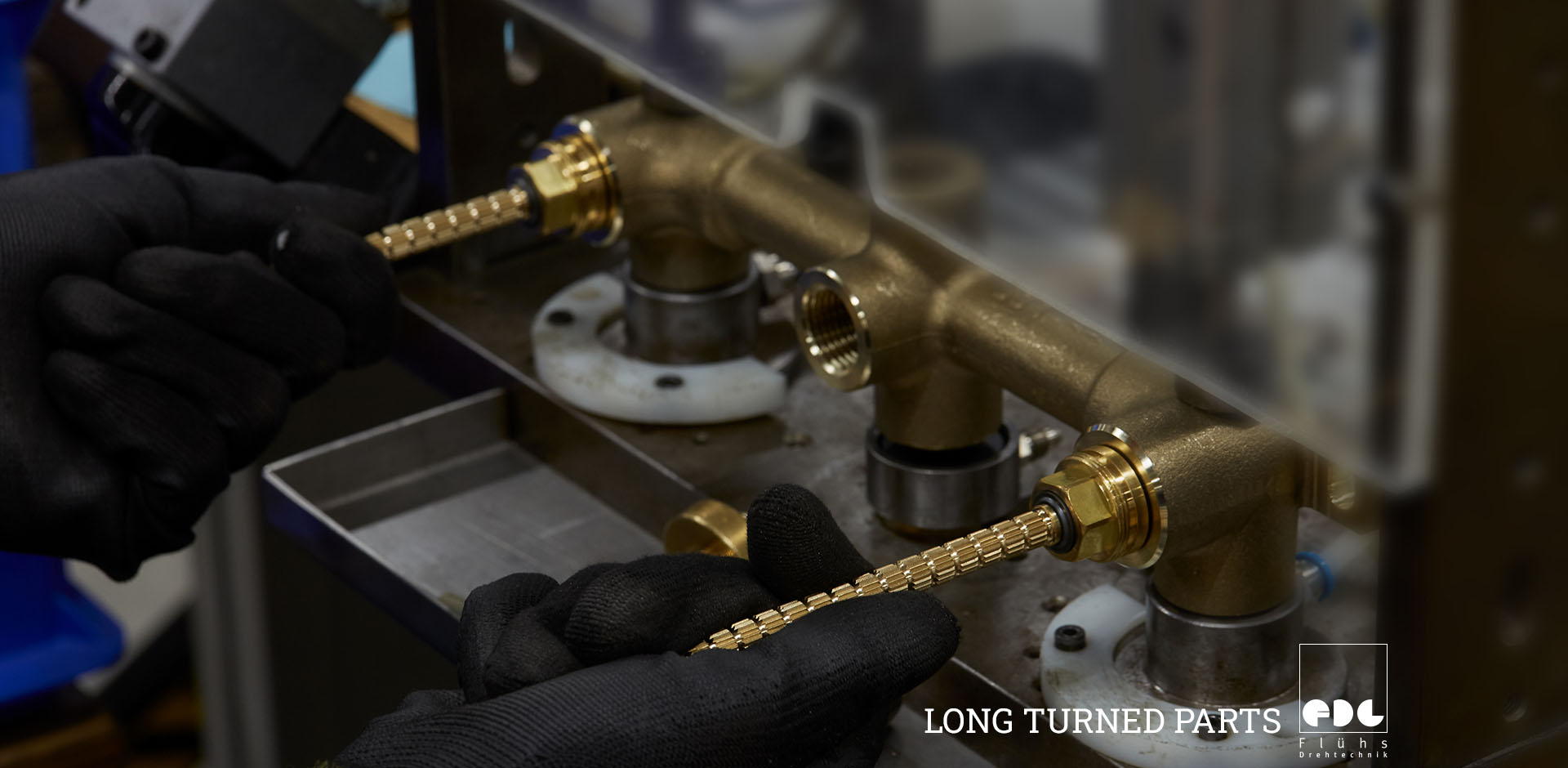
Long turned parts are manufactured using special CNC long turning machines by means of longitudinal turning (round turning) and/or face turning.
In general, there are 2 turning processes that are also used for long turned parts: longitudinal turning, also known as round turning, and face turning.
In longitudinal turning, the turning tool moves parallel to the axis of rotation of the workpiece, creating cylindrical shapes, such as shafts or rods. In face turning, the turning tool moves perpendicular to the axis of rotation of the workpiece, creating flat surfaces, such as end faces.
In order to produce precise, high-quality long turned parts, a number of process-specific features must be taken into account during production.
With long turned parts in particular, it is important that the workpiece is clamped securely in the lathe, as otherwise breakage or deformation easily occurs. For long turned parts, it may therefore be advisable to use step-by-step machining, in which only part of the workpiece is fixed in the lathe using clamping devices. The workpiece is then machined in several sections from the front to the rear to prevent deflection or unwanted vibrations.
Particularly in the case of complex long turned parts, it makes sense to adjust or further subdivide the production steps in order to avoid effects such as deformation and unevenness. For example, rough pre-turning may be carried out first so that the workpiece becomes shorter or can be clamped more stably. When set correctly, parameters such as speed and feed rate help to minimize vibrations in the workpiece.
The use of CNC long turning machines makes it possible to guarantee variable quantities while maintaining the highest quality standards. In this way, individual long turned parts can be produced in small, medium, and large series.