Mixing Valve: All Types

Mixing Valve: All Types | Flühs

The mixing valve is a frequently requested product at Flühs Drehtechnik, which ensures a consistent temperature at the outlet of the respective fitting by mixing cold and hot water and providing precise temperature control.

Flühs Drehtechnik is a reliable manufacturer of valve and system technology, currently offering over 1,400 active valve assemblies that are installed in sanitary fittings around the world.

If you have any questions about our mixing valves, please contact info@fluehs.de or call us on +49 2351 975-0.

Mixing valves combine cold and hot water to ensure a specific temperature. The different types of mixing valves vary depending on the type of fitting in which they are installed.

This text provides an overview of mixing valves, outlining the various types available and their respective advantages.

What does a mixing valve do?

A mixing valve ensures that the water in a heating or hot water system is brought to a specific temperature or does not exceed a specific temperature by blending hot and cold water in the appropriate ratio.

A mixing valve is a type of control valve with 2 inlets and at least one outlet. Mixing valves have a hot water inlet, a cold water inlet, and at least one outlet for the mixed water. An example of the use of a mixing valve is a sink faucet.

The water temperature is adjusted by turning the spindle of the mixing valve. In the middle position, cold and hot water are mixed in equal proportions. Turning to the right increases the proportion of cold water, turning to the left reduces it. This simple mechanism ensures precise and user-friendly temperature control. The mixing valve is designed without volume control and shut-off function. Shut-off is provided by a separate unit within the washbasin fitting.

Mixing valves can be installed in both radiators and sanitary facilities, such as shower, bathtub, or washbasin fittings. In both cases, mixing valves regulate the temperature by mixing cold and hot water, but with different objectives. Mixing valves for heating systems regulate the flow temperature of the heating system by mixing the flow and return water from at least one heating circuit. The temperature control can be adjusted to external conditions such as weather and usage pattern.

Mixing valves for sanitary fittings mix cold and hot water together to set the desired water temperature. With single-lever mixers, the temperature is controlled manually by turning the lever on the sanitary fitting. Single-lever mixers allow for continuous control of the water volume through linear movement of the lever. The temperature is controlled by turning the lever to the right (cold water) or left (hot water).

With thermostatic mixing valves, the required temperature is set once. Having set the individual comfort temperature, the thermostatic mixing valve automatically regulates the temperature. Manual readjustment of the temperature is not necessary with thermostatic valves.

There are different types of mixing valves depending on the number of water outlets to be served.

What are the different types of mixing valves?

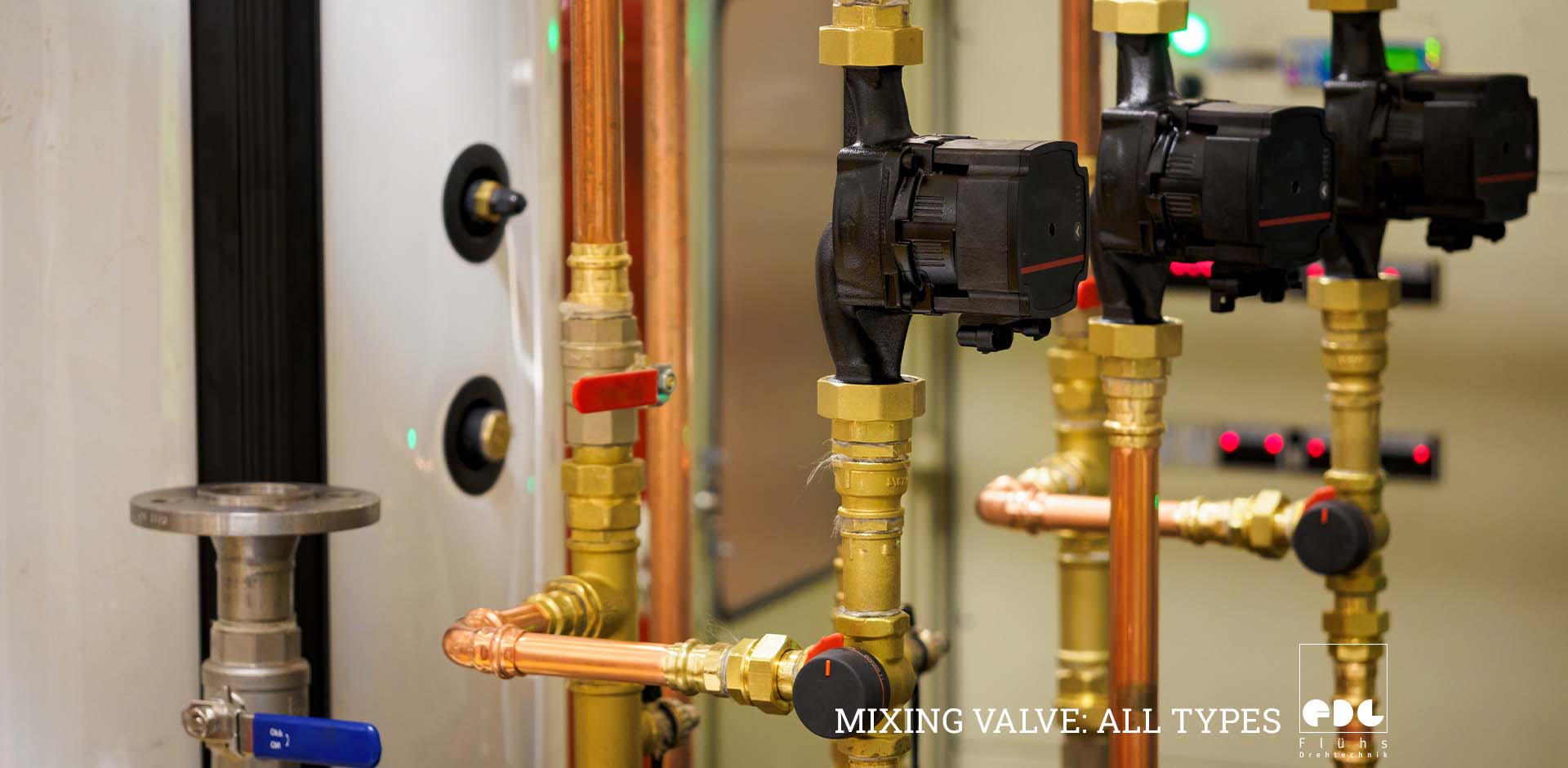
There are various mixing valves, including 3- and 4-way mixing valves, thermostatic mixing valves, and single-lever mixers, which can be installed in heating and cooling systems. Single-lever mixers and thermostatic valves are primarily used in sanitary fittings.

3-Way-Mixing Valve

3-way mixing valves (or 3-way mixers) are mixing valves that have 3 connections and mix 2 volume flows with different temperatures. 3-way mixers in heating systems mix the return water from the heating circuit with hot flow water from the boiler. They feed the mixed water back into the flow of the heating system. Depending on the configuration, the temperature in the heating circuit can be either increased or decreased.

4-Way-Mixing Valve

4-way-mixing valves are mixing valves that have 4 connections. A 4-way mixer has one connection for the flow, one connection for the return, and 2 outlets. The 2 outlets are intended for the heating circuit and the boiler return. 4-way mixers are used in heating and cooling systems to control the flow and return water from two heating circuits. The mixing ratio of the flow and return water is controlled by adjusting the partition inside the mixer.

Thermostatic Mixing Valve

A thermostatic mixing valve is a mechanical component that mixes cold and hot water to ensure a constant water temperature. A thermostatic mixing valve offers the advantage of ensuring a constant water temperature. A wax element inside the valve mechanically opens or closes the cold and hot water inlets to the thermostatic cartridge depending on the pressure in the inlet pipes. This compensates for pressure fluctuations in the cold and hot water pipes and ensures a constant water temperature. When 2 faucets in the same household are operated simultaneously, the outlet temperature of the mixed water remains unchanged thanks to a thermostatic valve. Flühs Thermostar valves ensure a constant water temperature and can be combined with diverter valves (for example, the Flühs Motion valve) to serve multiple outlets.

Single-Lever Mixer

A single-lever mixer is a fitting with only one control element for infinitely variable regulation of the flow. Single-lever mixers are the most widely used mixing valves for sanitary applications. Common areas of application for single-lever mixers include kitchen, washbasin, shower, and bathtub fittings. The control element can be used to regulate the water temperature and flow. The single-lever mixer has 2 ceramic discs that open the cold and hot water inlets by turning or turning and sliding. This blends the cold and hot water. Flühs offers a wide range of suitable single-lever mixers with its Promix valves and its Progressive and Mix valves.

Flühs Mixing Valves

Mixing valves from Flühs are high-quality, reliable components in sanitary fittings that are the result of decades of experience and research and development.

Flühs mixing valves are designed for use in drinking water fittings.

The Flühs Progressiv is a mixing valve with ceramic discs that is particularly suitable for energy-saving single-lever fittings. The Flühs Mix is similar in design, but does not have a shut-off function and is mainly used for sensor fittings.

Flühs Promix valves are available with various functional specifications and in different sizes. In addition to the energy-saving cold start function (Promix Cold Start), Promix valves can also be equipped with a higher torque. Promix valves with higher torque are used specifically in flush-mounted applications with large handles.

Flühs Thermostar valves are used as components in thermostatic fittings to compensate for pressure and temperature fluctuations, ensuring a constant mixed water temperature.

Our mixing valves are made of high-quality special brass, which increases corrosion resistance and wear resistance.

What are the advantages of a mixing valve?

The advantage of a mixing valve for heating systems is that it maintains optimal temperatures in the heating circuit.

In sanitary applications, a mixing valve is a convenient way to set the required temperature of the mixed water. A thermostatic valve ensures that the set temperature remains constant, regardless of fluctuations in the inlet temperature or pressure. Thermostatic valves also offer the option of integrating scald protection. Other advantages of mixing valves include improved energy efficiency and easy control of the mixed water temperature. Mixing valves can be implemented in electronic applications such as smart heating thermostats or electronically controlled applications for showers or washbasin fittings.

Contact

Form

We're looking forward to your message

Please fill in the blanks below and send us your questions and requests.